Llangollen Canal
Forty-one miles of narrow canal from the Cheshire plain up into Wales, crossing the Dee on Telford's great aqueduct
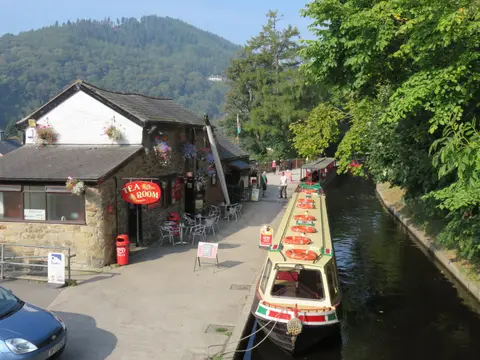
The Llangollen Canal leaves the Shropshire Union Canal at Hurleston Junction, on the plain near Nantwich, and runs some 41 miles west and then south into Wales, climbing through 21 locks to finish at Llangollen. It was built by Thomas Telford and William Jessop around the turn of the 19th century. The canal is narrow, with a beam under seven feet, and because it doubles as a water feeder drawn from the River Dee it carries a steady current back towards Hurleston; at the aqueducts and tunnels, boats pass in single file. It is the most-cruised canal in Britain, and moorings book up in summer. For a walker the towpath is continuous and mostly easy, with Whitchurch and Ellesmere the natural market-town stops and a scatter of lake-like meres just off the line near Ellesmere.
Its centrepiece is the Pontcysyllte Aqueduct, which carries the canal 38 metres above the River Dee in a cast-iron trough. Opened in 1805, it is the tallest navigable aqueduct in Britain, and in 2009 it and eleven miles of the canal around it were made a World Heritage Site. The towpath runs beside the trough, so walkers cross on foot with a railing at their side; boaters have open water on one hand and a long drop on the other. A few miles east the smaller Chirk Aqueduct and Chirk Tunnel carry the canal over and through the border hills.
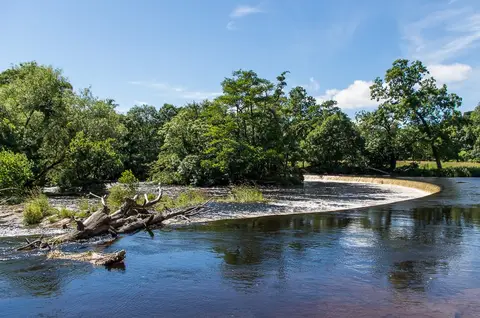
Above Llangollen the canal narrows to a feeder that runs on to Horseshoe Falls, a curved weir Telford built on the Dee to keep the whole waterway supplied with water. The line began as part of the Ellesmere Canal scheme of the 1790s, an unfinished plan to link the Mersey, Dee and Severn; the surviving fragments, including the branch to the Montgomery Canal, became the Llangollen only later.
It is easy to reach by road at Llangollen, Chirk, Ellesmere and Whitchurch, though it has no railway of its own — the nearest stations are Chirk and Ruabon, on the line through Wrexham. Llangollen, in Denbighshire, makes the obvious base, at the scenic head of the canal.