Forth & Clyde Canal
Thirty-five miles coast to coast across the Scottish waist, from the Forth at Grangemouth to the Clyde at Bowling
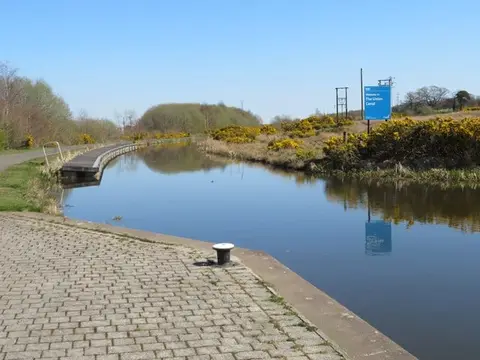
The Forth & Clyde Canal crosses the narrow waist of central Scotland, 35 miles (57 km) from Grangemouth on the Firth of Forth to Bowling on the River Clyde. Opened in 1790, it was the first canal to link the country’s east and west coasts, letting seagoing vessels pass between the two firths rather than sail round the north of Scotland. It climbs and falls through some forty locks, and its towpath is continuous and level, running along the northern edge of Glasgow and through Kirkintilloch and towards Falkirk.
Its most striking feature is modern. At Falkirk the canal is joined to the higher Union Canal by the Falkirk Wheel, a rotating boat lift opened in 2002 that lifts boats between the two waterways in place of a flight of eleven locks lost when the canals fell derelict. The wheel was the centrepiece of the Millennium Link, the scheme that restored both canals to navigation.
The canal was surveyed by John Smeaton and begun in 1768, a slow and costly undertaking that reached the sea at both ends by 1790. For a century it carried coal, goods and passenger boats between Glasgow and Edinburgh, but the railways took its trade, and by the mid-20th century new roads had been built across it at fixed low levels, cutting it in pieces. It was reopened throughout in 2001 as part of the same restoration that built the wheel, and it now serves walkers, cyclists and pleasure craft the length of the crossing.