An Early English Gothic cathedral built in one campaign under the tallest spire in England, with an original Magna Carta in its chapter house
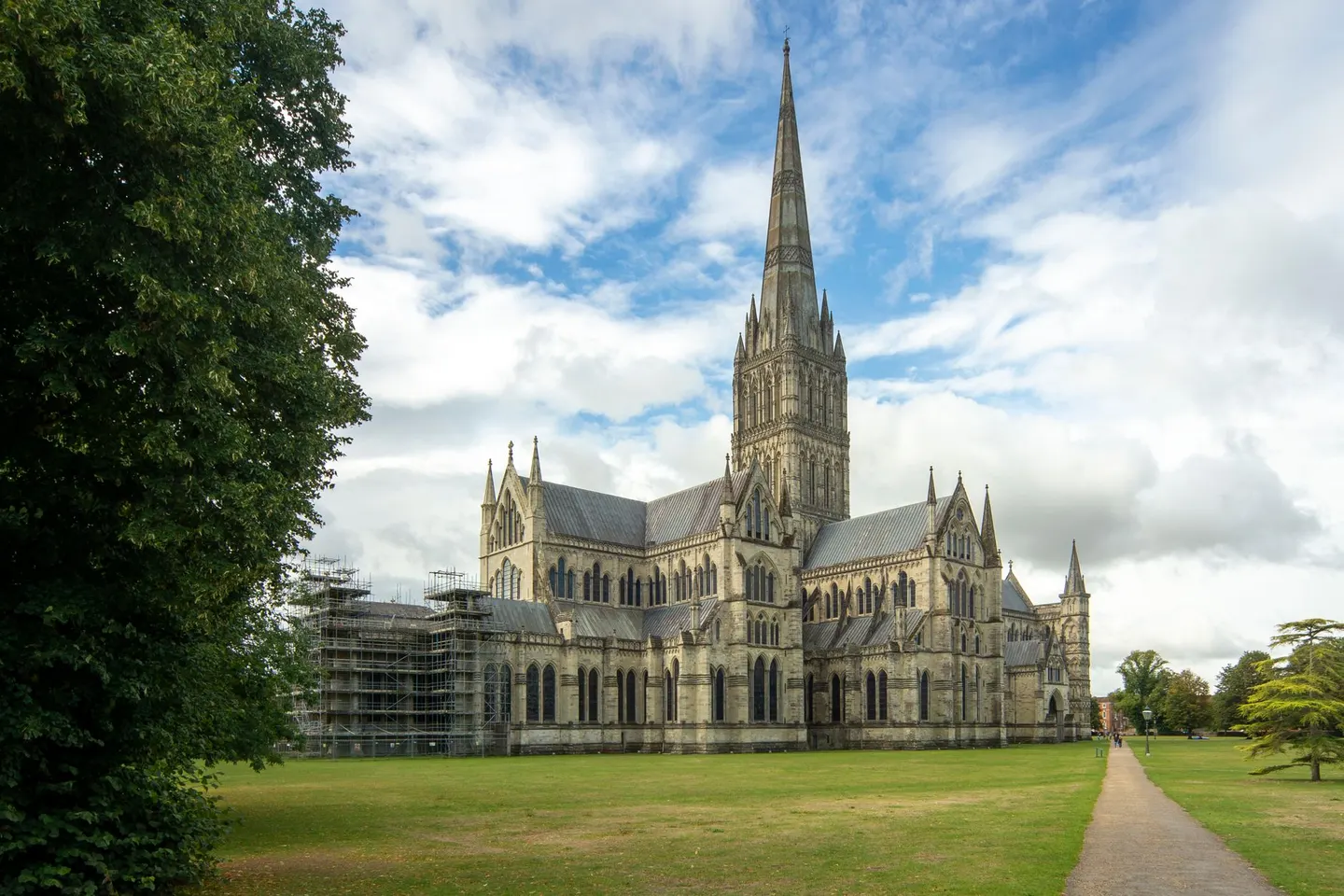
Salisbury Cathedral went up fast by medieval standards, in 38 years from 1220 to 1258, so almost all of it is in one style, Early English Gothic: tall, narrow pointed windows and slim shafts of dark Purbeck marble. The tower and spire were finished by 1330, and at 123 m the spire is the tallest in England. Its weight bent the piers below, and in 1668 Christopher Wren added iron tie-beams across the crossing, which stopped the movement.
The cathedral moved here from Old Sarum, the hilltop about 3 km north where the first cathedral stood inside an old earthwork fort. Inside the new one you’ll find one of the oldest working clocks in the world, and in the chapter house, the eight-sided room where the clergy met, one of the four surviving originals of Magna Carta from 1215. Tower tours climb up inside to the base of the spire.
The cathedral stands in the largest close in Britain, a broad lawn ringed by old houses, among them Arundells, once the home of the prime minister Edward Heath. It is a short walk from the centre of Salisbury, and Salisbury station is under 1 km away. Stonehenge is about 13 km north.