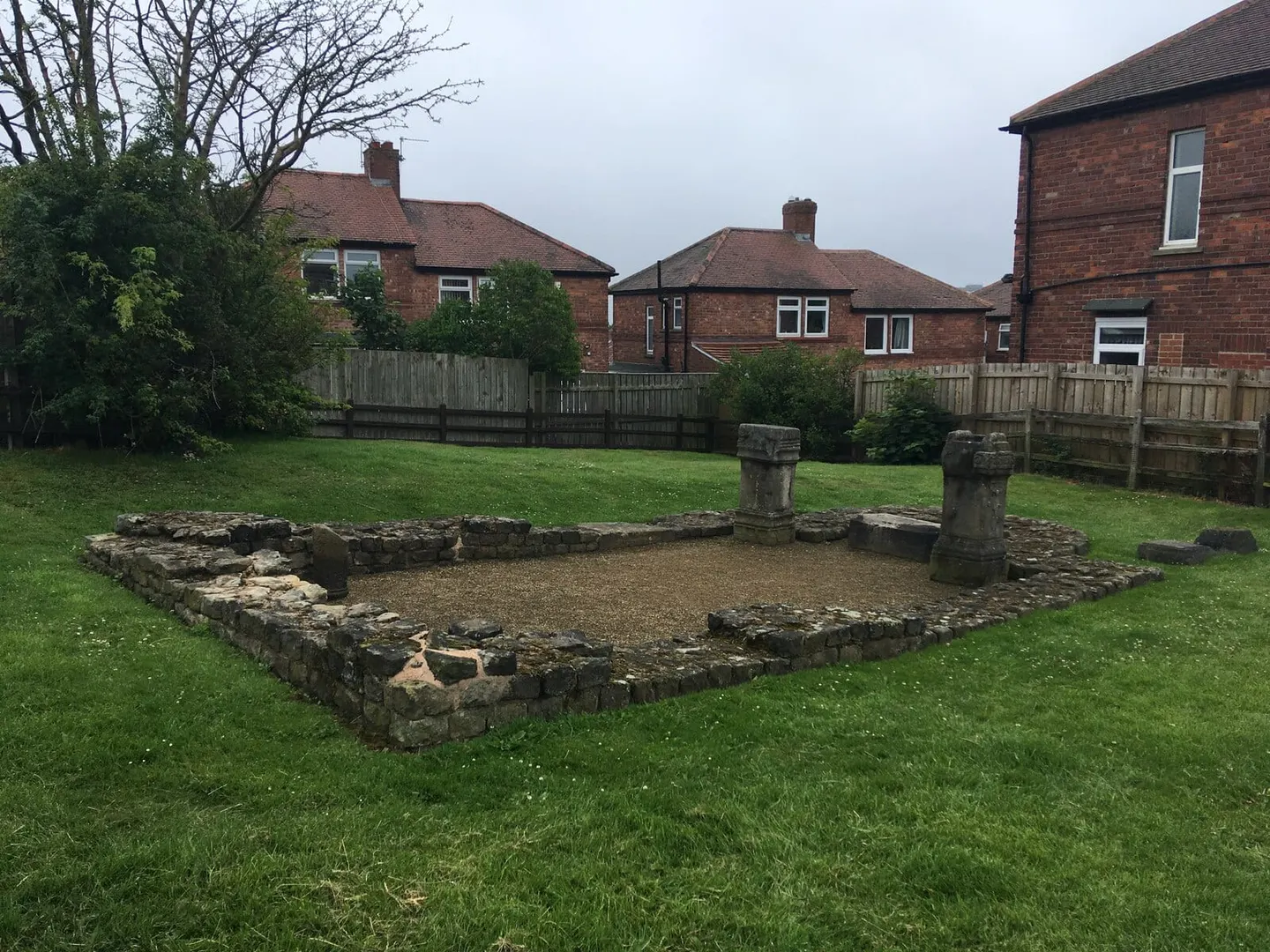
Housing built in the 1930s hems in the ruins of a small Roman shrine to Antenociticus, an obscure local god
Open accessfree to visit at any reasonable time
Substantial ruinsruined, but plenty survives above ground
Benwell’s Roman fort, Condercum, is gone now, buried under a reservoir built in Victorian times and a grid of 1930s streets, but sixty metres to the east the low walls of a small temple still stand. Soldiers and civilians from the community that grew up beside the fort worshipped here. One of three altars found on site names a cavalry officer, Tineius Longus, who set it up around AD 178-80, not long after his promotion to quaestor, a Roman civil post that let him wear a senator’s broad stripe. The other two altars were put up by a 20th Legion officer, perhaps standing in as temporary commander, and by the prefect of a cohort originally raised in the Rhineland. All three name the same god, Antenociticus, recorded nowhere else in the Roman world, probably a purely local deity.
Inside, the ground plan is a small rectangle, about five metres by three, with a rounded end wall known as an apse that now displays the base of a cult statue, found originally by the temple’s north wall, and, separately, a carved stone head of a young god that mixes classical and native styles, the single most striking find from the site. People kept using the spot after the temple went out of use. Three skeletons were buried in the apse, and Anglo-Saxon-era brooches and a small glass vessel turned up nearby in the 1930s.
A little further west stands Benwell Vallum Crossing, the only surviving crossing point of the Vallum, the ditch-and-mound earthwork that marked the rear of the Roman military zone behind Hadrian’s Wall. Both sites are free to look round, any day of the week.