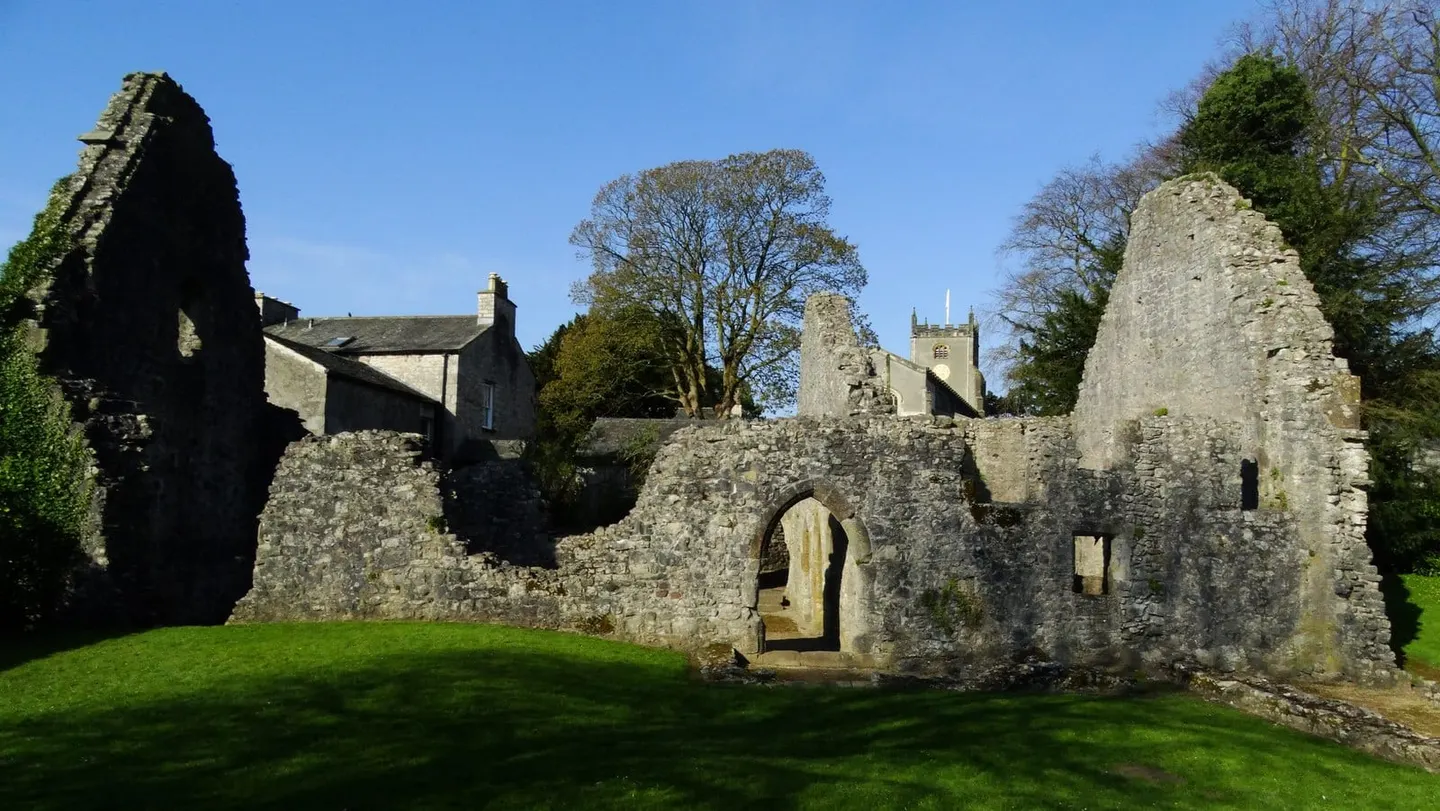
A roofless medieval stone house from the 1300s beside Warton's parish church, built for rectors wealthy enough to hold their own manor court
Open accessfree to visit at any reasonable time
Warton’s old rectory, built for the rectors of the parish church opposite, is an unusual survivor — a grand medieval house built for parish clergy rather than a lord or a monastery. It went up in the early 1300s, probably built by two sons of the local landowner Marmaduke de Thweng, both priests, after they inherited his estate; under them it housed Warton’s rectors, among the better-off clergy of their day, for generations.
The rector’s job here came with legal power as well as spiritual duty. Courts were held on site, with the great hall doubling as a courtroom. A passage split the hall from service rooms at the north end, and windows lit the hall on its east and west sides, along with a four-lobed quatrefoil window; below that survives a raised dais where the rector sat, whether at dinner or presiding over a court case.
It escaped the Dissolution (Henry VIII’s 1530s closure of England’s monasteries) simply because it belonged to a parish rather than a monastery. Exactly when it was abandoned isn’t recorded, but it was already crumbling into ruin by 1721. One corner of the house remained lived in, as a cottage, right into the 1900s, long after the rest lay derelict; once the state took the site into guardianship in 1971, those later additions were cleared away. It’s free to wander round whenever you’re passing. Warton Crag rises right behind it, its summit ringed by the earthworks of the Iron Age Warton Crag hillfort, and Leighton Hall Gardens is a short way south.