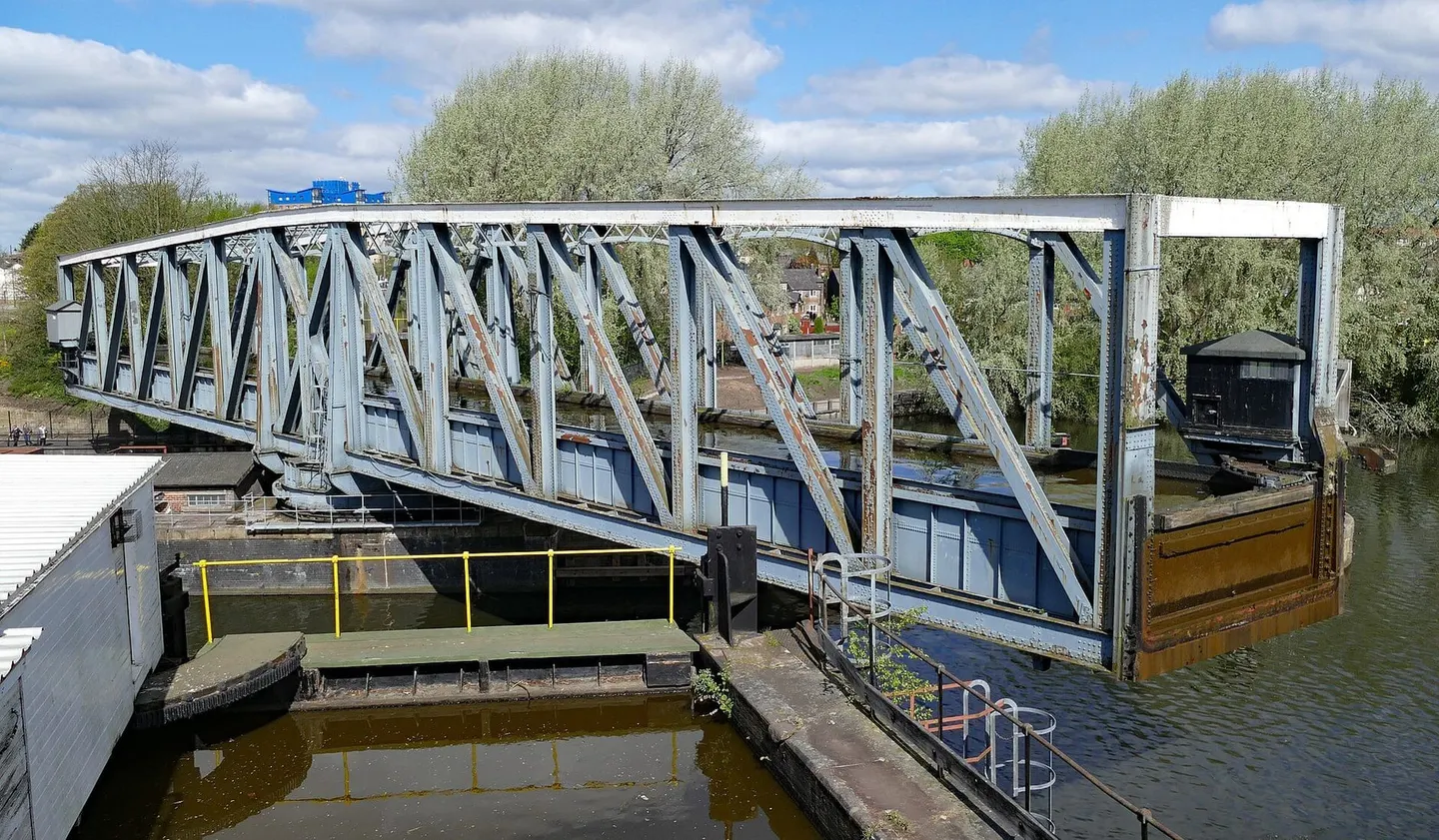
An iron trough of canal that pivots on a central island to let ships pass beneath, the only swing aqueduct of its kind
Barton Swing Aqueduct carries the Bridgewater Canal over the Manchester Ship Canal at Barton, west of Manchester. It is a wrought-iron trough about 235 feet long, holding water, canal and any boats on it, that swings sideways on a pivot set on an island in the middle of the ship canal. When a large vessel needs to pass, gates seal the trough at both ends, the whole span turns parallel to the ship canal carrying some 800 tonnes of water with it, and it swings back into line once the ship is through. It is the first and only swing aqueduct ever built.
It was designed by the ship canal’s engineer, Sir Edward Leader Williams, and opened with the ship canal in 1894. It replaced a stone aqueduct built by James Brindley in 1761, which had carried the Bridgewater over the River Irwell and was itself a famous early feat of canal engineering; the new ship canal, cut to take seagoing ships, needed far more headroom than Brindley’s arches allowed, so his aqueduct was demolished and this one built to take its place.
The aqueduct still works, swinging when shipping requires, though such movements are now rare. It is a scheduled structure and a Grade II* listed one. There is no public access onto the aqueduct itself, but it is easily seen from the road bridge and towpaths at Barton; the neighbouring Barton Road swing bridge turns on the same principle for traffic.