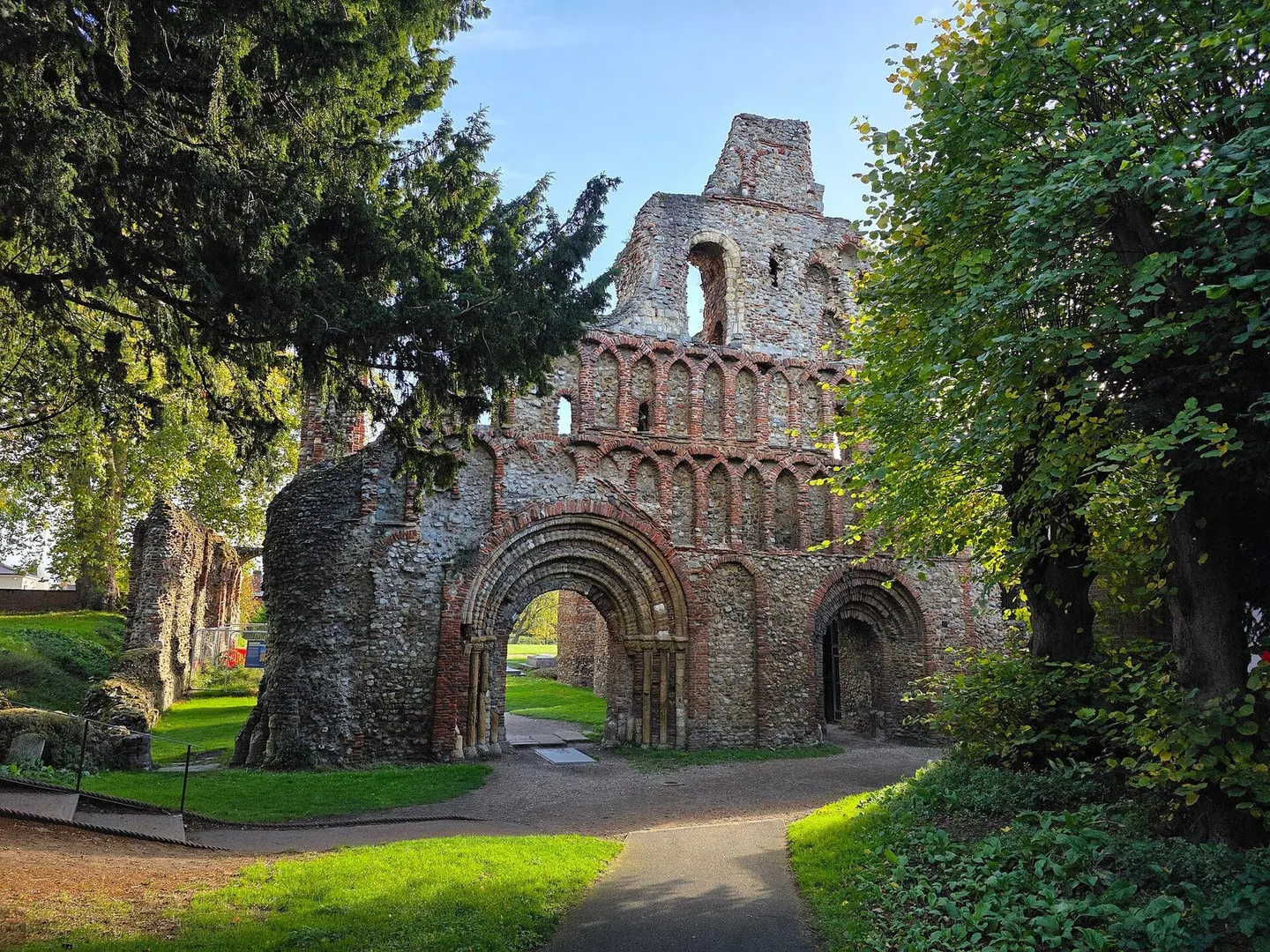
Round Norman arches of reused Roman brick stand roofless beside Colchester Town station, left from one of England's first Augustinian priories
Open to visitorsan English Heritage site — check opening times and admission before you go
Substantial ruinsruined, but plenty survives above ground
The builders of St Botolph’s had the ruins of a Roman town on their doorstep to quarry. Colchester had been Camulodunum, and the priory church went up in flint rubble with its arches and trimmings in Roman brick. That shows best in the nave, where you walk between huge round piers banded with the brick, under plain round arches.
Sometime between 1093 and 1100 a group of priests here became Augustinian canons, clergy who lived together under a rule like monks. They were among the first in England to do so, but the priory stayed small and poor, and the church took decades to finish. Its west front, done around 1150, is the showpiece, with three doorways carved with zigzag chevrons, two tiers of interlacing arches in Roman brick, and part of a big round window.
Henry VIII closed the priory in 1536, but the nave carried on as the parish church until Parliament’s guns wrecked it in the 1648 siege of Colchester. It was never repaired, and a new parish church went up alongside in 1837.
The ruins sit in public grounds at the edge of the town centre, free to walk round during daytime opening hours, a couple of minutes from Colchester Town station. St John’s Abbey Gate, gatehouse of a far richer abbey, is a few hundred metres south-west, and Colchester Castle is about 400 metres north.
Full name: St Botolph's Augustinian Priory
More at the National Heritage List entry