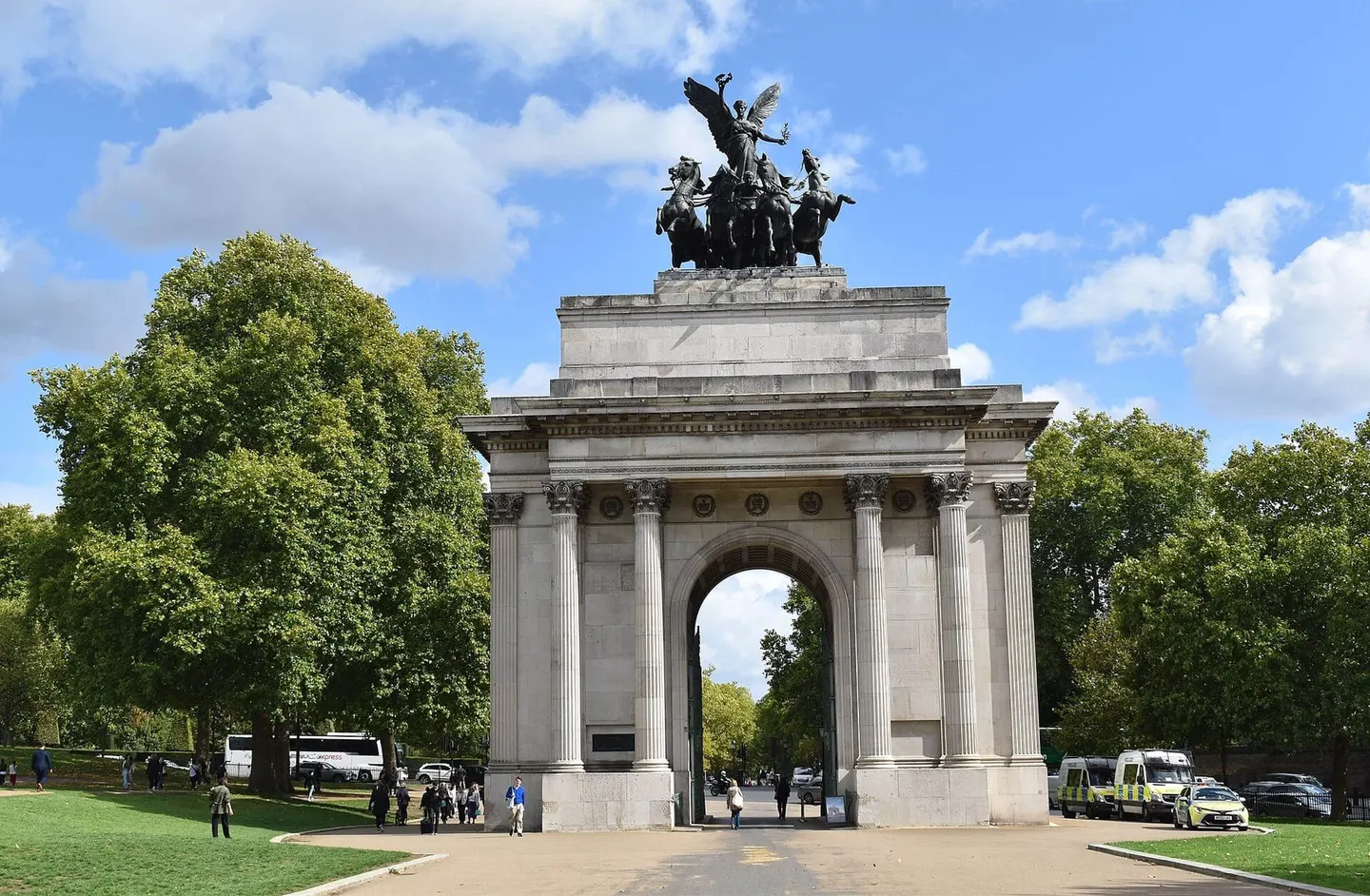
A triumphal arch built by Decimus Burton in the 1820s at Hyde Park Corner, topped with Europe's largest bronze sculpture
Open to visitorsan English Heritage site — check opening times and admission before you go
A bronze chariot appears to fly above the traffic at Hyde Park Corner. It’s a four-horse chariot, called a quadriga, with a winged figure of Peace descending above a young charioteer who seems not to notice her, put in place in 1912; the sculpture, by Adrian Jones, is the largest bronze in Europe.
Decimus Burton designed the arch itself in the 1820s as a grand gateway close by, planned at first as an outer gate for Buckingham Palace, which was then being rebuilt nearby for George IV; money ran short before most of the intended carving could be added. From 1846 a vast, wildly oversized equestrian statue depicting the Duke of Wellington stood on the arch instead, mocked by the press and the Royal Academy for decades; only Wellington’s own threat to resign his public offices kept it there, until the 1880s, when the whole arch was dismantled, moved a little further off to its present site facing down Constitution Hill, and the statue was sent instead to Aldershot.
English Heritage restored the arch and opened it to the public in 2001; stairs and a lift lead up past small galleries to balconies with views back across Hyde Park and along Constitution Hill. The arch stands on a traffic island where Green Park meets Hyde Park Corner, one of London’s busiest junctions, so take care crossing; admission is charged to go inside.