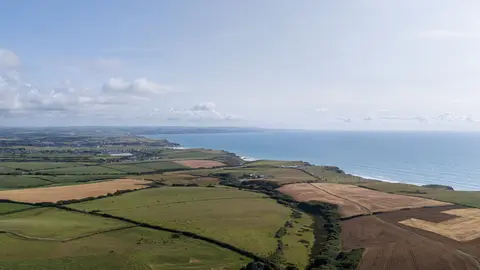
The grassy outline of the moated manor the de Cardinham family built near Week St Mary in north Cornwall in the 1200s
Open accessfree to visit at any reasonable time
Daphne du Maurier borrowed the name of the family who lived here for her 1968 novel The House on the Strand. The de Cardinhams were minor Cornish landowners who backed King John in the early 1200s and profited from it, rising high enough that Andrew de Cardinham could afford to rebuild the family’s manor house at Penhallam on an ambitious scale. It became a quadrangle of ranges built around a moat and courtyard, crossed by a bridge, put up mostly in the 1220s and 1230s.
Only foundations and low wall-stubs remain above ground today, but the outline survives complete, so you can walk the plan of the entire house. The entrance tower and chapel sat in the south range, private family rooms lay to the east, and the hall in the north range still shows the stone benches that lined its walls and the base of the top table, the dais. The line of a stone drain that once took waste from an upstairs latrine down to the moat is still visible in the east range, a tidier arrangement than many medieval houses managed.
Andrew de Cardinham died without a son around 1256, and within a few generations the manor had passed through heirs until it belonged to tenants rather than lords; people helped themselves to its stone once the roof eventually gave way. Archaeologists uncovered the whole layout again in a dig between 1968 and 1973. No ticket is needed; the site is a short walk in from the lane. Froxton Wood Castle is a few miles east.