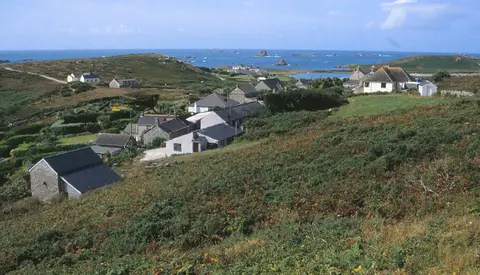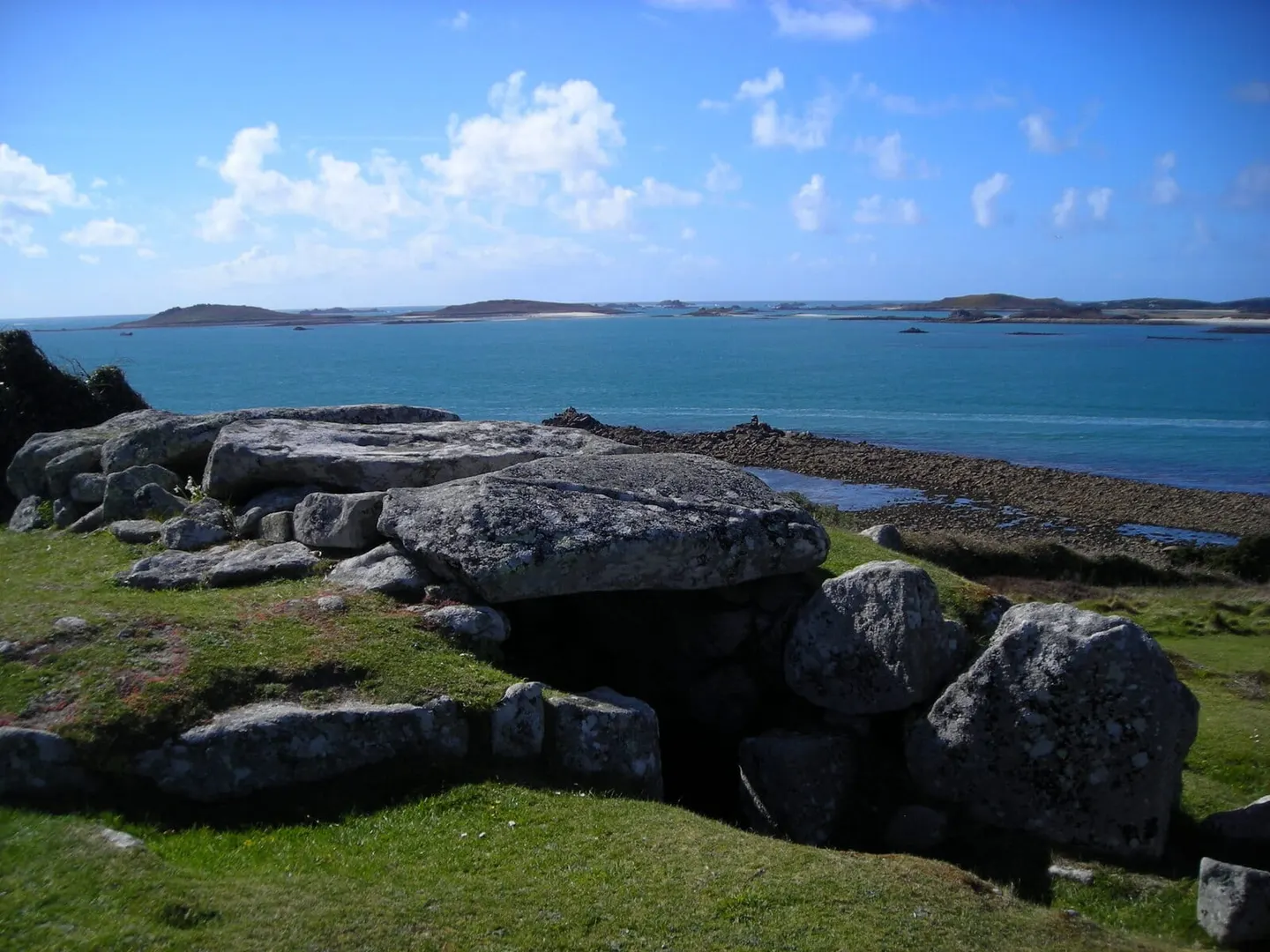
A Bronze Age tomb on a St Mary's hilltop, looking down over the stone footings of an Iron Age village and out to sea
Open accessfree to visit at any reasonable time
Standing remainssubstantial fabric survives to stand in front of
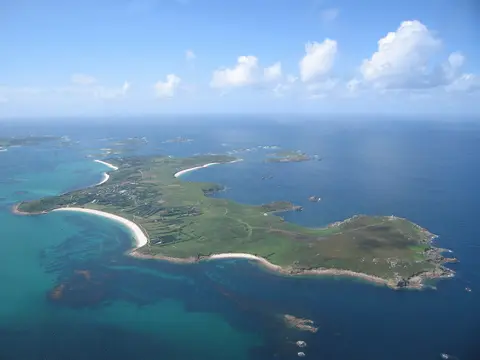
Bant’s Carn sits on top of a hill on St Mary’s, the largest of the Isles of Scilly, with the sea and neighbouring islands visible in more than one direction. It’s a Bronze Age entrance grave, a type of chambered tomb where a passage leads straight into a stone burial chamber under a mound, and one of around 80 known across Scilly, an unusually dense concentration for such a small area. The mound here is about eight metres across, built with a kerb of stone slabs, and the roofed chamber inside runs a little over five metres long under four huge capstones. When it was excavated in 1900 the tomb turned out to be largely empty, though diggers found four piles of cremated bone and some broken pottery at the far end.
Below the tomb, on the slope of Halangy Down, are the stone footings of a village occupied from the Iron Age into Roman times, roughly 500 years of continuous use. Eleven interconnecting stone houses cluster together, most of them simple ovals, and one much larger courtyard house has three rooms opening off a central yard, a style of building also found in other Iron Age villages in west Cornwall. Traces of the fields the villagers farmed are still visible as terraces on the slope between the two sites.
Getting there costs nothing — walk or cycle across the north-west corner of St Mary’s — and Innisidgen Burial Chambers, another pair of Scillonian entrance graves, lie a walk away along the coast to the east.